The list below includes some recent side-projects I worked on in my free time.
-
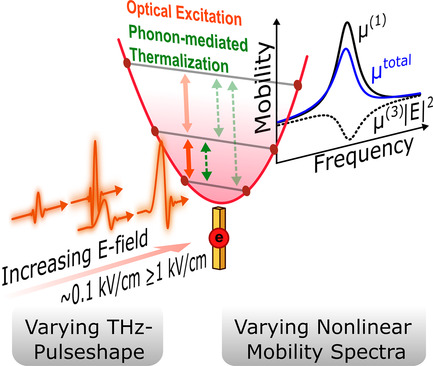
THz Response of Charge Carriers in Nanoparticles
Michael T. Quick,Quentin Wach,Nina Owschimikow,Alexander W. Achtstein
Presenting a new quantum mechanical theory that models the THz mobility of charge carriers in low-dimensional semiconductors, revealing nonlinearities even at low field-strengths as well as a quantum mechanical equilibration current that counteracts the mobility at low frequencies.
Advanced Photonics Research -
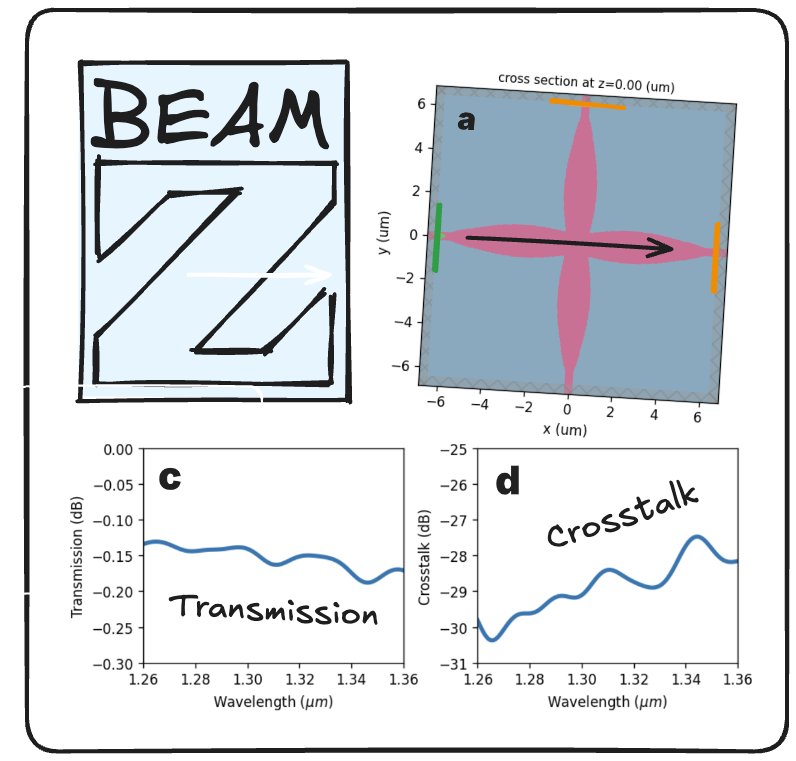
Waveguide Crossing with Cosine Tapers
This notebook models a compact silicon waveguide crossing with cosine tapers using BEAMZ. To achieve high integration density on a photonic chip, efficient routing of light with compact, low-loss junctions is necessary. The convex cosine taper focuses the guided mode at the crossing center so that most power is transmitted to the through port instead of scattering into the cross ports.
-
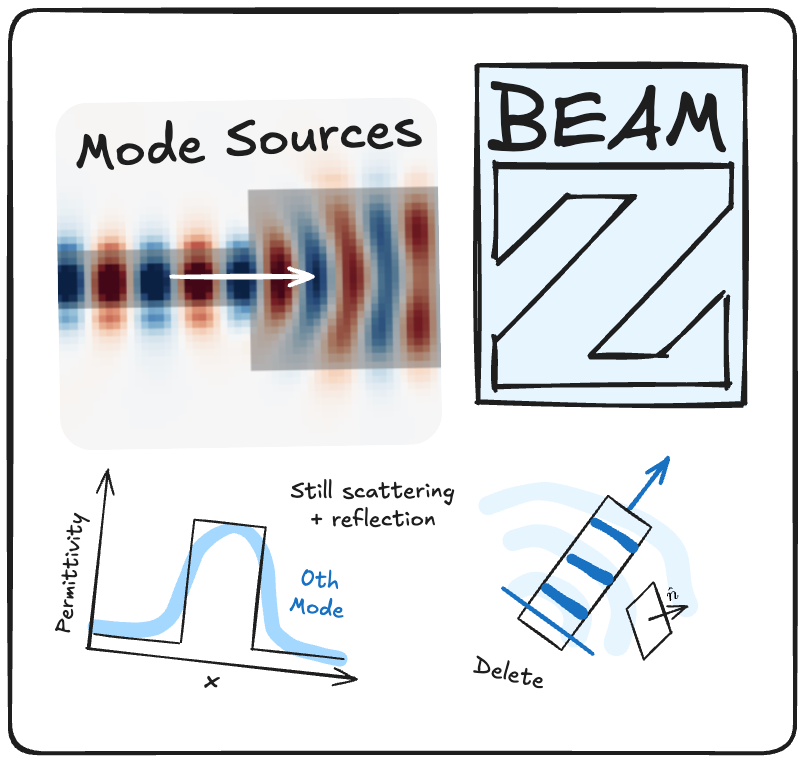
Mode Sources and Monitors
Another BEAMZ FDTD package demo where we launch one guided waveguide mode, verify the launched power in a straight reference waveguide, and then reuse the same source/monitor setup for a simple width-step junction. The important quantities are the frequency-domain fields, the total flux through a monitor plane, and the modal amplitudes returned by the mode monitor.
-
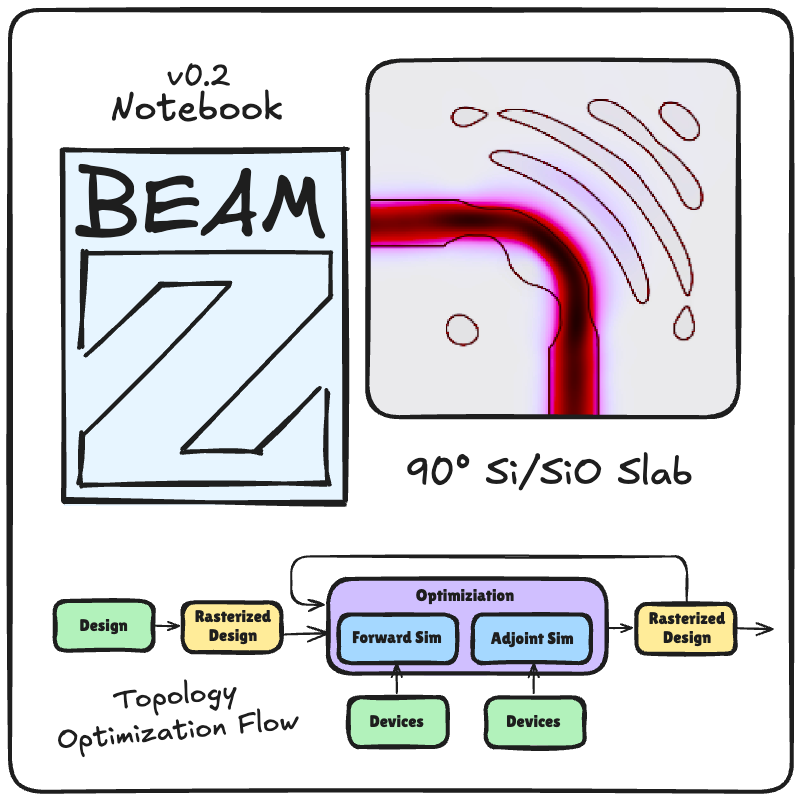
Topology Optimized 90° Bend
We use topology optimization to design a compact, efficient 90° photonic waveguide bend from first principles using BEAMZ. The optimizer maximizes bidirectional transmission through the bend by iteratively updating the refractive index distribution within a defined design region, using the adjoint method with a material penalty to control core material usage.
-
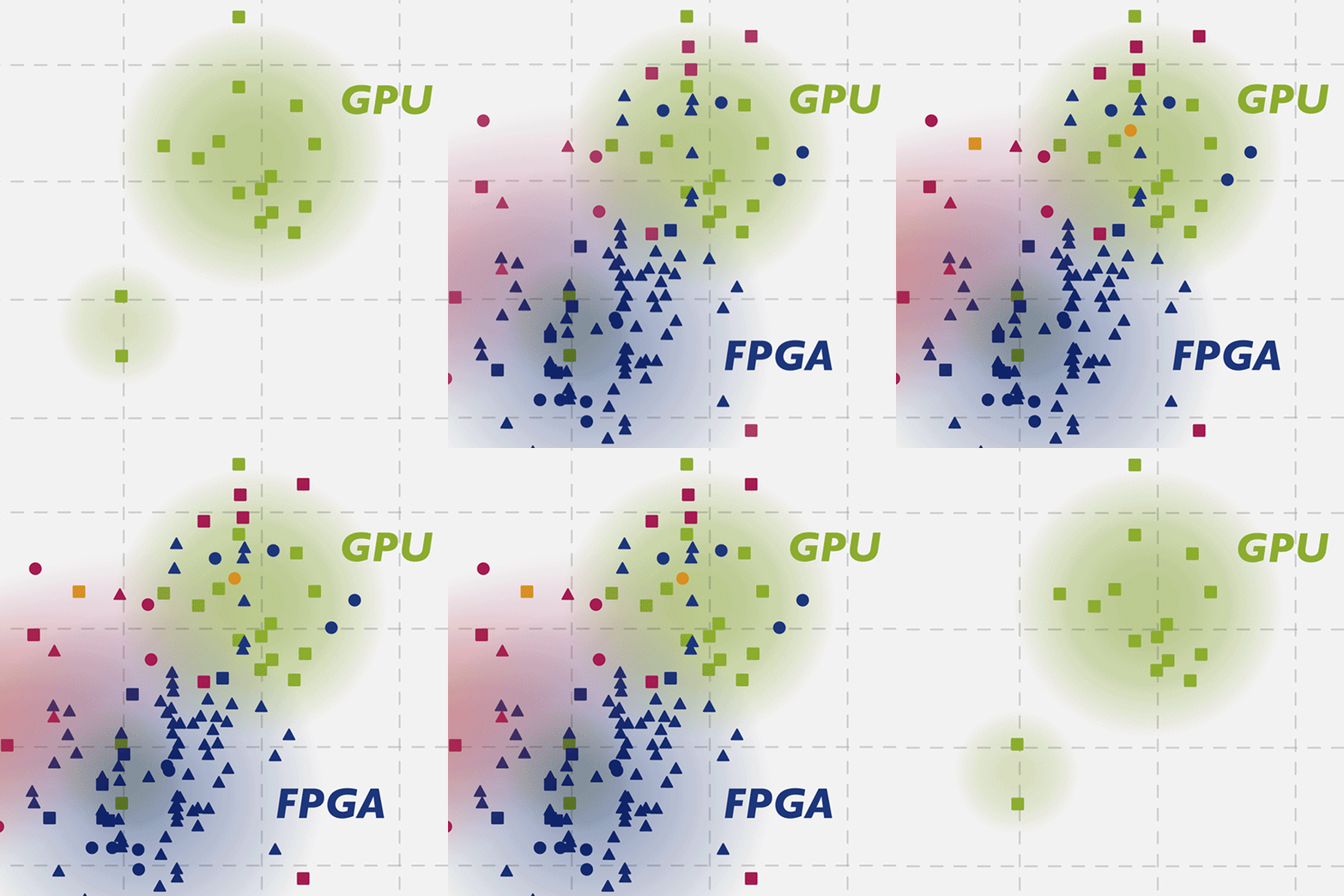
First Principle Physics of Computing
Moore’s law is both dead and alive and I here I want to clarify exactly how. Modern computers are based on incredibly simple ideas that we were able to scale up and optimize rapidly over the past 70 years. But we are at a point of transition to entirely new architectures, materials, and physics. This post is dedicated to answer the question of what the limits of computation are in principle, where we are today, what new computers offer as a solution, and what I believe is the future in the short and long-term.
-

Image Ranker: The Web App for Fast Ranking of Large Image Collections
Training generative image models requires a way to compare images and provide feedback on which images are better. I built a web app to do just that using the TrueSkill algorithm for accurate and fast Bayesian ranking and various other features.
star 72 -
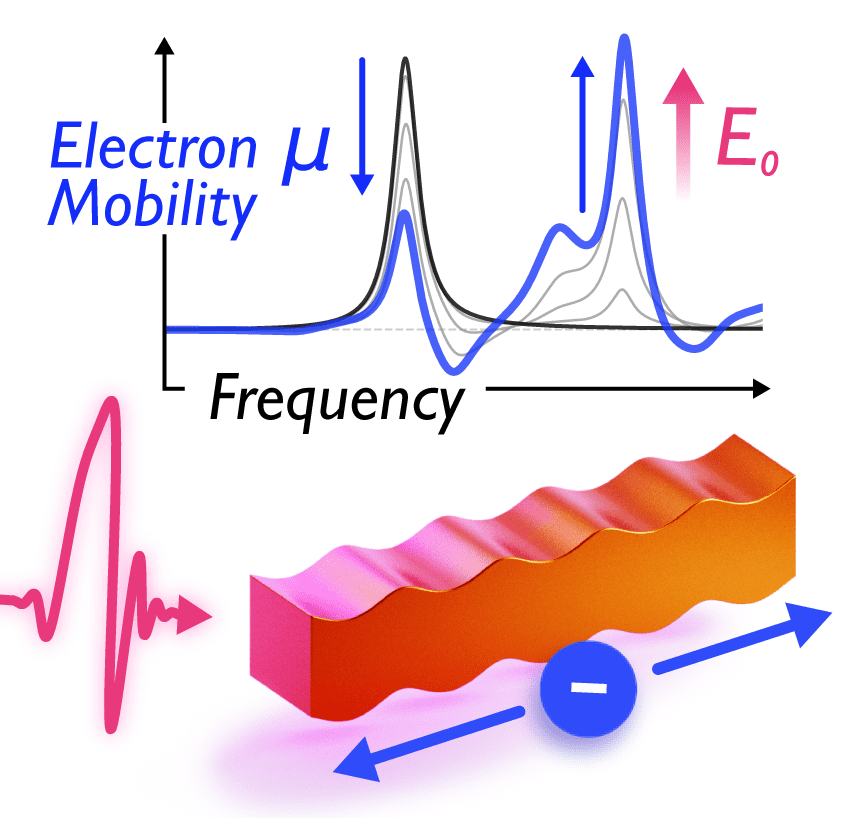
Field-Dependent THz Transport Nonlinearities in Semiconductor Nano Structures
Quentin Wach,Michael T. Quick,Sabrine Ayari,Alexander W. Achtstein
The charge transport in semiconductor quantum dots and nanorods is studied theoretically, predicting strong field-dependent nonlinear mobility effects and intra-pulse gain. We studied the temperature- and size-sensitive mobility spectra, crucial for applications like 6G tech and nano electronics in general.
PCCP